
Your ninth deal pays differently than your tenth
Aug 8, 2026 · 7 min read
You close two deals three months apart. Same price, same side, same commission rate, same brokerage. One nets you around seven thousand dollars. The other nets almost nine.
Nothing about the transactions was different, and nobody at the office can give you a straight answer about why.
The answer is your cap, and the reason it is confusing is that a cap does not change your split gradually. It changes it once, in the middle of one specific deal, and every deal after that one is worth more than every deal before it.
$7,200
deal 8, before the cap
$7,400
deal 9, straddling it
$8,750
deal 10, after
Same price, same side, same commission rate. The arithmetic is worked through below.
A cap is a ceiling on what the brokerage collects
Under a capped model you are on a split, commonly 80/20, and the brokerage's share accumulates against an annual ceiling. At eXp Realty that ceiling is $16,000 for the agent's anniversary year. Real Broker runs 85/15 against $12,000. Different numbers, identical mechanic.
The thing that accumulates has a name worth knowing: company dollar. The brokerage's cut. It is what the cap counts.
Your cap is not measured in deals. Not in volume, and not in what you take home. It is measured in dollars the brokerage has already collected from you this year, which is why two agents closing the same number of deals can cap months apart.
This is also the detail that produces most payout arguments. The threshold is measured in gross commission produced, not commission the agent has earned. Two different numbers, and only one of them counts.
Work it out on a real book
Say your average gross commission is $9,000, on an 80/20 split against a $16,000 cap.
Company dollar per deal is $1,800. Divide $16,000 by $1,800 and you get 8.89.
So you do not cap on a deal. You cap inside deal nine.
The track's right edge is the ceiling. Deal nine owes $1,800 but only $1,600 can land.
That leftover $200 has nowhere to go, so it stays with you.
| Deal | Gross | Company dollar | Post-cap fee | You keep |
|---|---|---|---|---|
| 8 | $9,000.00 | $1,800.00 | — | $7,200.00 |
| 9 | $9,000.00 | $1,600.00 | — | $7,400.00 |
| 10 | $9,000.00 | $0.00 | $250.00 | $8,750.00 |
$14,400 plus $1,600 is exactly $16,000. Deal nine is the last one that owes anything.
Same price, same side, same rate. A $1,550 spread between the first and the last.
Deal nine sits between them at a number that matches neither. That is the one that makes people think the accounting is broken.
Which deal straddles depends on the order they close
Every deal in your year is easy to price except one. Before the ceiling you keep your split; after it you keep everything minus a flat fee. The deal that crosses is a blend, and the blend depends on exactly how much room was left the day it settled.
So the arithmetic depends on sequence. Move a closing from March to May and a different deal becomes the straddler. The year totals the same, but every per-deal number shifts, and anything you have already reported no longer matches.
Which means a delayed closing is not financially neutral. A deal that slips from December into January restarts against a fresh cap year. It stops being your capped 100% deal and becomes deal one at 80/20.
On a $9,000 commission, that slip costs $1,800.
Post-cap fees have their own staircase
Capping does not stop the brokerage charging you. Most capped models substitute a per-transaction fee, and some step it down: at eXp, $250 per transaction until you have paid $5,000 in transaction fees, then $75 for the rest of the year.
Note anniversary year. Your cap year usually runs from your start date, not from January, while your tax year ends in December. Two sets of numbers that will never line up on one page.
A closed deal's number is a fact, not a formula
Here is the part that catches spreadsheets, and it caught us too.
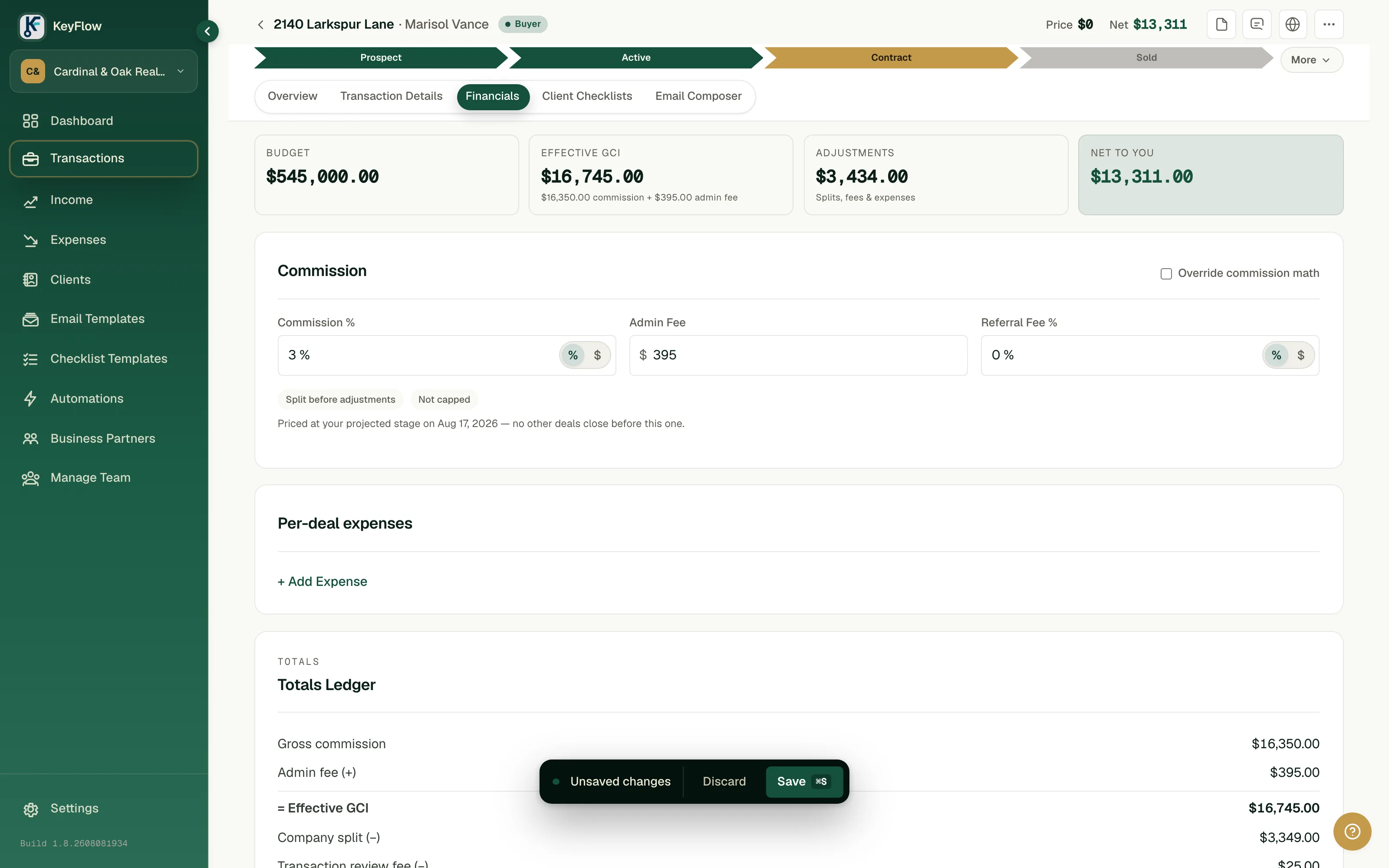
We once spent an afternoon convinced our own commission figures were broken: a heading that totalled one number over rows that added to a different one. Both were right. They were answering different questions, and they only disagreed when a deal carried a fee that differed from the usual one, so on ordinary data they matched perfectly and we had been looking at ordinary data for months.
The general shape is the thing to take away.
Once a deal closes, what you cleared on it is settled. It was determined by where you stood on the cap that day. Go back in November, recalculate March's deal using November's cap position, and you get a smaller number, because by November the ceiling is full and the formula prices that deal as post-cap.
A spreadsheet that derives every row from a current-position formula quietly reprices your entire year every time you open it. The totals you gave your accountant in April will not reproduce in October. Nothing warns you. The formula is doing exactly what you told it to.
We think this is the single most common way commission tracking goes wrong, and it is structural rather than careless. The spreadsheet is wrong by design, not by accident.
Back-office systems are not immune either. Commission reconciliation is described as one of the most error-prone processes in brokerage operations, where a 5% error rate across 100 transactions a year means five agent payment disputes. Five arguments a year, at one brokerage, about whose arithmetic is right.
The fix is unglamorous. Store what each deal actually paid, at the moment it paid it, and treat that stored figure as the record. Recompute only what has not closed.
What this does not tell you
None of the above is tax advice, and it is not your brokerage's model. Caps, splits, transaction fees, admin fees, and whether a fee applies before or after capping all vary between brokerages and sometimes between agents at the same brokerage. The mechanic is general. The numbers are not. Read your independent contractor agreement (ICA).
The useful part is smaller. Your deals are not worth the same as each other. One of them each year is worth a third number that is neither. The order they close in is part of the arithmetic. And if your records are derived rather than stored, last year's numbers are not last year's numbers anymore.
We build KeyFlow to price each deal at the cap position you were actually in the day it settled, and to hold settled deals still afterward. It is the specific behaviour we found hardest to get right, and the reason we noticed our own header disagreeing with its own table.
Sources: Smart Agent Alliance — eXp Realty commission and fees · Speicher Group — Real Broker commission split, cap, and fees · eXp Realty commission split, cap, and fees (2026) · US Tech Automations — automating commission split reconciliation
- commission
- cap
- money