
Three years, three rebuilds, and a hundred closings before anyone else saw it
By Lester Marcano, founder · Aug 16, 2026 · 8 min read
You can usually tell within ten minutes whether the person who built your software has ever done your job.
It shows up in small places. A field for something nobody tracks. No field for the thing you check daily. A "close date" that is required, on a buyer who has been looking for four months. A commission figure that is technically correct and not the number you actually take home.
None of that is incompetence. It is distance. Somebody described the job to somebody else, who built what they heard.
Jun 2016
our first house, after seven years of renting
2020 · 2024
the years Meralis and I got licensed
100+
closings run through this software since, all of them ours
Ten years from not understanding how to buy a house to writing the software for the people who sell them.

It started on her laptop
My name is Lester Marcano. I am an electrical engineer with about two decades of writing software behind me. My wife Meralis has been selling real estate in the Cincinnati area since 2020, after five years in banking. For a long time my contribution to her business was carrying boxes and proofreading flyers.
She says something about her clients that I did not expect to end up describing the software:
People are not scared of buying a home. They are scared of not understanding it.
We learned that one from the other side first. Seven years of renting, a relocation to Cincinnati, and in June 2016 a first house we had been qualified to buy long before we felt able to. The obstacle was never the money. It was that every answer changed depending on who we asked.
Meralis was licensed four years later. I took another four after that. Neither of us set out to end up here.
That sentence turns out to describe the agent's side of the table just as well. An agent is not scared of their cap. They are scared of not being able to see it. Not scared of a deadline, but of not knowing which ones just moved. Not scared of the commission math, but of a number that changed at some point and did not mention it.
Then I started paying attention to where her time actually went.
Not the showings. Not the negotiating. Not the parts of the job she is good at and enjoys, which is most of it. The other hours: re-deriving deadlines after a closing moved, rebuilding a commission estimate in a spreadsheet because the last one no longer matched, answering the same three questions from the same client for the third time that week.
She was also coordinating transactions for two other agents at the time, on top of her own book, which multiplied every bit of it.
None of it was difficult. All of it was necessary. And all of it was the kind of work that expands to fill whatever evening happens to be available.
Three versions, over three years
Each version was replaced because of what it could not do, not because it stopped working.
November 2023. The first version was not a product. It was a set of scripts that ran on her laptop and nowhere else, automating the specific things she was doing by hand. It worked, for exactly one person, on exactly one machine.
February 2025. The second lived inside a Gmail add-on, because that is where the work actually happened. The contract arrives as an attachment, the questions arrive as replies. Much closer to the job, and bounded by somebody else's product in ways I kept running into.
October 2025. Rebuilt properly, as the thing that exists now. By that point the requirements were not guesses. They were two years of notes about which parts kept breaking.
December 2024, in the middle of that, I got a real estate license myself.
The order matters more than I realised at the time. The first version was built for somebody else, from watching. Both rebuilds came after I had my own files in it, my own deadlines to miss, and my own commission to be wrong about. Being your own most irritated user is an excellent product strategy, and it is not the same thing as being a sympathetic observer.
The part I did not expect
The goal was to give her evenings back. It did that.
What I had not planned for is that it also raised her ceiling. Coordinating for two other agents on top of her own book had been about as much as the week could hold, because the administrative half expanded to fill whatever time existed. When that half took minutes instead of evenings, the constraint moved.
She took on more business. Not by working more hours — by stopping the hours from being eaten.
That is the outcome I would point at if you asked me what this software is for, and it is not the one I set out to build.
What I found is that the tooling divides cleanly. The brokerage's systems are built for the brokerage — compliance, document retention, oversight — and they are good at that. They exist so the broker can see the file, and they do that well.
What nobody had built was the other half. The half where you are running a small business with a cap, a split, a set of deadlines that move, and a client asking where things stand. That half lived in a spreadsheet, a calendar, and my head.
I wrote it because I could, and because the spreadsheet kept being wrong.
Every feature ran a real closing before it shipped
This is the part that matters, and it is the reason the numbers on this site are the shape they are.
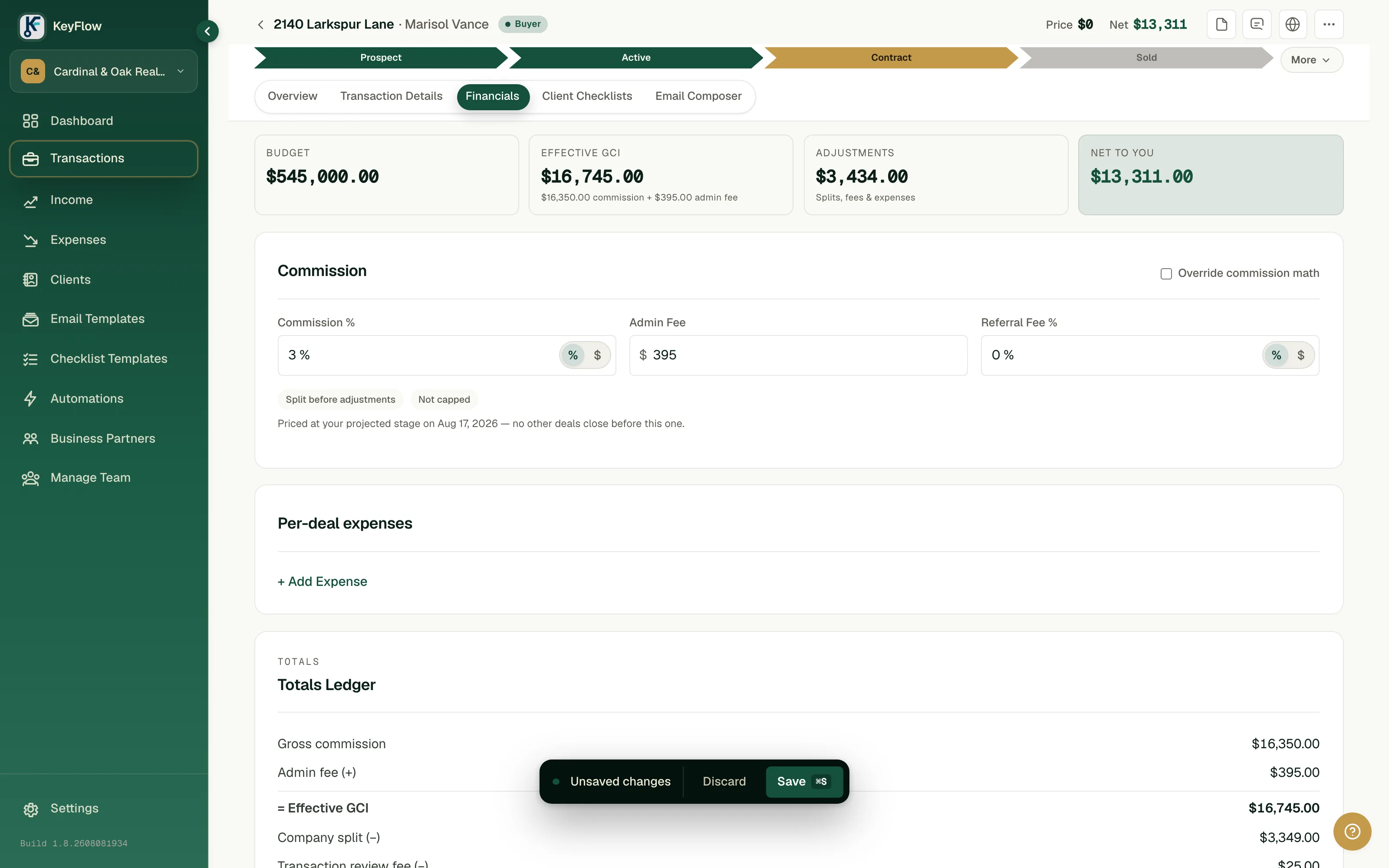
The commission engine was not designed against a specification. It was built because I needed to know what I was actually clearing on a deal, and then corrected repeatedly when it disagreed with the settlement statement. The contract date logic exists because a closing moved and six deadlines went stale in my own calendar. The client portal exists because my wife's clients kept asking the same three questions at the same three points, and answering them by phone from a showing is a bad way to spend a Tuesday.
Real transactions. Over a hundred of them, ours and the ones Meralis coordinated for two other agents, with real money and real deadlines, across nearly three years before any of it was offered to anybody.
That has a cost worth stating: it means the product is shaped by two agents in one market. A team lead in a different state with a different contract and a different brokerage model will find things it assumes. Some of those assumptions I already know about. Some I do not, which is what the private beta is for.
What the time actually bought
Time is not quality on its own, so here is where it went.
Every change is checked against an automated test suite before it reaches anyone's account. Not because the number of tests is interesting, but because of one specific failure I wanted to make hard: commission math that silently changes is far worse than commission math that visibly breaks. A total that quietly becomes a different total is a number you cannot trust again, and you usually find out months later while reconciling something else.
Several articles on this site are about bugs those tests did not catch anyway, which is the honest argument for having more of them rather than fewer.
The screenshots on this site are captures of the running application, loaded with a fictional book of business so that no real client's file appears anywhere. When one of those screenshots showed a number that did not add up, it turned out the software was wrong and we fixed the software.
What it is not, today
I would rather you hear this from me than discover it.
It is not a finished commercial product. It is a private beta. It is free while it lasts, and the pricing after that has not been set, which is why no number appears anywhere on this site.
It does not replace your brokerage's systems. Compliance and the official transaction record belong there.
It is opinionated in ways that will not suit everyone. Anniversaries are buyer-only. The portal has no password. Settled deals do not re-price. Each of those is a decision I would defend, and each is a decision somebody will disagree with.
Why I care about the ownership part
The thing I keep coming back to is not a feature.
An agent's production history, client list, and commission records are the record of their career. In most of the tools available, that record lives in an account somebody else controls, and the day the affiliation ends the record does too. I have watched that happen to people. It is not malice; it is a routine offboarding checklist doing what it says.
So the account is yours here, the workspace is yours, and everything in it exports to a spreadsheet from a button in Settings without asking anyone. That is not a feature I added. It is the reason I started.
If you are running your own book and any of this sounds like your Tuesday, the beta is open, and I would genuinely like to know what it gets wrong in your market.
- product
- about